On this page
- Why does casing wear damage drill pipe tool joints?
- How do abrasive cuttings wear tool joints near the bit?
- How does dogleg severity multiply tool joint wear?
- How does rotational speed drive tool joint wear?
- How do mud weight and mud quality affect tool joint wear?
- Which wear modes consume tool joint life?
- When does hardbanding pay off economically?
- Key takeaways
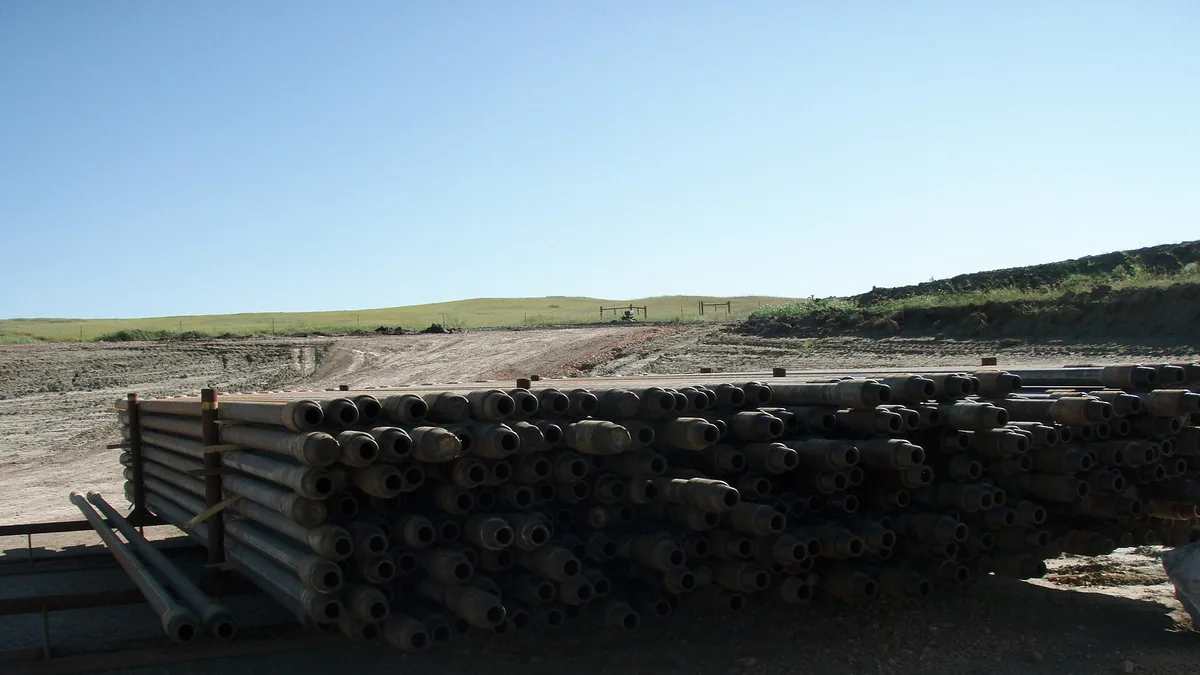

Drill pipe tool joints wear out because they carry the pipe’s full torque and axial load while also being the only part of the drill string that regularly contacts casing and the hole wall. Between casing friction, abrasive cuttings, dogleg-induced lateral loads and rotational speed, the tool joint absorbs wear mechanisms that the pipe body itself largely escapes. Understanding those mechanisms is what tells you where hardbanding pays off, and where it is wasted money.
This article walks through each wear mechanism, how they interact, and the practical rules of thumb drilling engineers use to decide when hardbanding earns its keep. For the broader picture on alloy selection and application, see Oilfield Hardbanding: The Complete Field Guide.
Why does casing wear damage drill pipe tool joints?#
Casing wear is the leading cause of drill pipe tool joint wear. The tool joint is larger in diameter than the drill pipe body, typically by an inch or more, which means the tool joint rubs against casing and the borehole wall, not the pipe. Every rotation under lateral load removes metal from the tool joint OD, and in casing that same rubbing also thins the casing wall. Tool joint wear and casing wear are two sides of the same frictional process, which is why the problem deserves attention from both the drilling and the casing integrity side.
The mechanics are straightforward. When the drill string rotates in a deviated or bowed section of hole, gravity and tension press the tool joints against the low side of the casing or open hole. The contact pressure, the sliding speed of the tool joint surface, and the friction coefficient between tool joint steel and casing together determine how fast metal disappears. Hardened tool joint steel (typically around 30 to 37 HRC on the OD in the as-machined condition) is harder than most casing grades, so the casing usually loses material faster than the bare tool joint, which is why unhardbanded pipe is notorious for casing wear failures.
What are the practical consequences of tool joint OD wear?#
There are three practical consequences:
- Tool joint OD loss reduces torque capacity. The tool joint is the threaded connection that carries all make-up torque and axial load. As its OD wears, thread flank engagement and shoulder integrity degrade, and eventually the joint needs re-cutting, which shortens it and retires the joint when the shoulder width drops below the minimum specified.
- Worn tool joints wear casing faster over time. Once a groove or flat develops on the tool joint OD, contact pressure concentrates in a narrow band, accelerating casing loss in that track. A single worn tool joint can machine a groove into casing across thousands of feet if it stays in the same position in the string.
- Hardbanding converts the wear pair. A properly applied hardband layer takes the contact instead of the tool joint base metal, and casing-friendly alloys are designed so the casing loses far less material than it would against bare steel. How those alloys work is covered in How Hardband Alloys Resist Abrasion Downhole.
The key insight most operators miss: casing wear and tool joint wear are the same event. Budget for them together, because a casing failure from wear usually costs an order of magnitude more than the hardbanding program that would have prevented it. That downtime math is worth working through explicitly, and we cover it in The Cost of Skipping Hardbanding: Downtime Math.
How do abrasive cuttings wear tool joints near the bit?#
Abrasive cuttings wear drill pipe tool joints by acting as a lapping compound wherever the drilling fluid carries them, and cuttings concentration is highest near the bottom of the hole. While casing wear attacks the tool joint OD in the wear band region, abrasive cuttings attack everything the drilling fluid touches. The lower third of a drill string runs through the highest solids loading, the most angular formation particles, and in fast drilling sections the highest rate of fresh abrasive being generated per hour.
How this plays out on the tool joint:
- Cuttings entrained in the mud act as a lapping compound between the tool joint and the hole wall or casing. Quartz-rich cuttings from sandstone and hard shale sections are the worst offenders, since quartz sits near the top of common downhole abrasives on the hardness scale.
- The tool joint shoulder and bevel see erosion from fluid flow during connections and while tripping, especially in wells with poor hole cleaning where cuttings settle and get re-entrained.
- Tool joints near bit see the combined effect: high cuttings concentration plus higher vibration, so they wear on the OD and can suffer galling on thread surfaces if the protective hardband has been worn through.
Rules of thumb for cuttings-driven wear: pipe in the bottom third of the string will typically show measurably more OD wear than pipe near surface in the same well. If you are hardbanding a full string but operating a dedicated bottom-hole assembly or heavy-walled pipe near bit, prioritize those joints first. Hardband applied to the wear band does not protect the threads themselves, so thread compound quality, proper make-up torque and clean connections do work that hardbanding cannot.
How does dogleg severity multiply tool joint wear?#
Dogleg severity (DLS), usually expressed in degrees per 100 feet, is the single best predictor of casing and tool joint wear rate in a well because it drives lateral contact force. In a perfectly straight hole, a rotating drill string rides on a fluid film and wall contact is light. In a dogleg, tension in the pipe below or above the bend presses the tool joints hard against the outside of the curve.
The load mechanics work like this: as pipe bends through a dogleg, the pipe body bows away from the wall and the tool joints, being stiff, concentrate the contact. The lateral force on a tool joint grows with tension in the string at that point and with the angle change across the interval. This is why tool joints near the top of a build section, where tension is highest, often wear fastest, not the joints nearest bit.
How does wear expectation change with dogleg severity?#
Some working guidance:
| Condition | Typical DLS (deg / 100 ft) | Wear expectation | Hardbanding case |
|---|---|---|---|
| Straight vertical hole | Under 1 | Light, mostly cuttings-driven | Inspection-driven, optional |
| Gentle directional work | 1 to 3 | Moderate casing and OD wear | Hardband pays on long rotating hours |
| Aggressive build or lateral | 3 to 8 | Heavy OD wear, casing risk real | Hardband strongly justified |
| Rotary-steerable curves, high DLS | Over 8 | Rapid wear, casing failure likely without mitigation | Hardband plus casing-friendly alloy essential |
A useful field habit: pull the DLS survey for the interval where each tool joint rotated, and map OD wear measurements against it. Joints that spent time in the build usually show the wear band, and joints that spent time in the lateral show uniform OD loss. That mapping tells you which joints to rotate out of high wear positions and which to recondition first.
How does rotational speed drive tool joint wear?#
Rotational speed drives tool joint wear because frictional wear scales with sliding distance, and sliding distance per downhole day is set by RPM. A tool joint rotating at 150 RPM travels roughly twice the surface distance of one at 75 RPM, everything else equal. When operators speed up rotation to increase rate of penetration or improve hole cleaning, they also double the wear mileage on every tool joint in the string.
The interaction with lateral load matters more than RPM alone. Tool joint wear in a straight vertical section at 200 RPM can be trivial, because contact pressure is low. The same 200 RPM in a 6-degree dogleg can be devastating. When troubleshooting wear rates, always read RPM together with DLS and string tension, never on its own.
Practical guidance:
- High RPM is most costly in the upper string, where tension through doglegs is highest. That is where sliding velocity and contact load combine worst.
- Motor drilling (bit rotating on a downhole motor while the string turns slowly) reduces string RPM dramatically and is one of the cheapest tool joint wear mitigations available, independent of hardbanding.
- When planning extended rotating hours in curved sections, budget hardband inspection intervals accordingly. More rotating hours means shorter effective life for both hardband and bare tool joint steel.
How does sliding wear differ from rotating wear?#
Sliding wear while oriented with a mud motor is a separate mode again: the tool joint does not rotate against casing but scrapes along it while sliding, which creates a different, often narrower wear track and can be more aggressive on casing per foot drilled. Wells that spend long intervals sliding deserve the same hardbanding scrutiny as wells that rotate fast.
How do mud weight and mud quality affect tool joint wear?#
Mud weight affects tool joint wear in two competing ways: heavier mud improves cuttings transport and deposits a lubricating filter cake, but the weighting materials themselves can be abrasive. Understanding the balance prevents overconfidence in either direction.
First, the helpful effect: heavier mud transports cuttings better, so cuttings concentration in the annulus drops and the lapping action between tool joint and wall weakens. Heavier mud also tends to deposit a tougher, thicker filter cake on permeable formations, and that cake is a boundary lubricant between tool joint and hole wall. The density of the mud itself also adds hydrodynamic support to the string, slightly reducing wall contact in near-vertical sections.
Second, the harmful effect: weighting materials are themselves abrasives. Barite is soft relative to quartz and is mostly benign, but hematite-weighted muds and cement-contaminated muds carry hard, angular particles that accelerate tool joint OD wear on their own. A heavy hematite mud can transport cuttings well and still be more abrasive to tool joints than a lighter barite mud.
What are the rules of thumb for mud-related tool joint wear?#
Rules of thumb for mud-related wear:
- Hole cleaning problems (settled beds, re-entrained cuttings) do more tool joint damage than mud weight itself. Fix transport velocity before blaming the fluid program.
- Hard-weighting-material muds (hematite, recycled cement solids) justify hardbanding at lower DLS thresholds than barite muds.
- Oily mud systems generally lubricate tool joint to casing contact better than water-based systems, so friction and wear rates per rotating hour tend to be lower, an effect separate from cuttings transport.
The hardband alloy choice interacts with all of this, and casing-friendly versus abrasive formulations behave very differently in mud. See Casing-Friendly vs Abrasive Hardband Alloys for how to match alloy to the wear pair you actually have.
Which wear modes consume tool joint life?#
Tool joint life is consumed by four distinct wear modes, each with a different failure path: casing friction, abrasive cuttings, sliding wear, and connection wear. Only the first three are addressed by OD hardbanding; the fourth is managed through connection practices, torque monitoring and inspection.
| Wear mode | Where it hits | What it destroys | Primary driver |
|---|---|---|---|
| Casing friction | Wear band on OD | Tool joint OD, casing wall | Lateral load, RPM, hours |
| Abrasive cuttings | Lower string, near bit | OD finish, bevel, shoulders | Cuttings loading, formation abrasiveness |
| Sliding wear | Lateral sections | Narrow OD track, casing | Sliding distance, friction coefficient |
| Connection wear | Threads and shoulders | Sealing and torque capacity | Make-up practice, thread compound, vibration |
A pipe management program that hardbands the OD but neglects connection maintenance is spending money on one failure mode while ignoring another.
Inspection is the feedback loop for all of this. Periodic tool joint OD measurement, wear band profile checks and thread inspection tell you which mechanism is consuming life fastest in your specific wells. Acceptance criteria for hardband condition matter as much as initial application quality, and are covered in Hardbanding Inspection and Acceptance Criteria.
When does hardbanding pay off economically?#
Hardbanding pays off when the wear exposure in a well crosses the threshold where savings in tool joint steel, casing wall thickness, and trip and repair time exceed the cost per joint applied. The economic logic is simple in principle; the question is whether your wells cross that threshold. These field rules of thumb give you a starting point:
- Dogleg severity over roughly 3 degrees per 100 ft on rotating pipe: hardbanding is almost always justified, and casing-friendly alloys should be mandatory if the string rotates inside casing for long hours.
- Extended rotating hours inside casing: a string that will rotate inside the same casing interval for hundreds of hours wears casing even at low DLS. Cumulative rotating hours inside casing is a better trigger than DLS alone.
- High-angle laterals and sliding sections: hardband pays even at modest DLS because sliding wear per foot drilled is aggressive, especially in water-based mud.
- Heavy-weight or hard-solids mud systems: lower the trigger threshold, since the mud itself is abrasive.
- Straight, shallow vertical wells with short rotating hours: hardbanding often cannot pay for itself. Budget inspection and prompt re-cut instead, and hardband only the joints that show actual wear band development.
- Casing repair or replacement cost exceeding the hardbanding program: this is the decisive comparison. If a casing wear failure in the producing or intermediate string costs more than hardbanding the entire string, the decision is made for you.
What cautions apply when applying hardbanding?#
Two additional cautions. Hardbanding worn tool joints without removing the cold-worked, fatigued surface layer can lock in problems, so surface prep before reapplication matters, as discussed in Re-Applying Hardband Over Existing Deposits. And choosing the wrong alloy for the wear pair, for example an aggressive abrasive alloy where the string rotates against casing, can protect the tool joint by destroying the casing, which is exactly backwards. The comparison in Tungsten Carbide vs Chromium Carbide Hardbanding explains the trade-off.
Key takeaways#
- Tool joint wear and casing wear are the same frictional event: if your string is wearing casing, it is wearing tool joints, and hardbanding addresses both at once.
- Dogleg severity and string tension set lateral contact load, which is the multiplier on every other wear mechanism. Map OD wear against the survey, not just against depth.
- RPM is sliding distance: faster rotation means more wear per day, but only where lateral load exists. Read RPM together with DLS and tension, never alone.
- Mud weight helps through cuttings transport and filter cake, but hard weighting solids can be abrasive on their own. Fix hole cleaning before blaming fluid design.
- Hardbanding pays when DLS exceeds roughly 3 degrees per 100 ft on rotating pipe, when rotating hours inside casing accumulate into the hundreds, in long sliding laterals, or whenever a casing wear failure would cost more than the program.
- In straight, short-rotating-hour wells, inspection and prompt re-cut usually beat blanket hardbanding. Spend the money where the wear mechanisms actually live.
- Drill pipe tool joint
- Barite
- Hematite
- Quartz
- Hardbanding
- Rotary steerable system
- Bottom-hole assembly